
Owning an explorer means owning geology and jurisdiction risk together.
For Marvel shareholders, Tanzania's settings determine how exploration rights are held, what a future mine would pay, how the State participates and how projects move through approvals. The country has large gold systems and long-running mines, but it also went through a sharp policy reset from 2017. Understanding both sides puts Hanang in context without pretending jurisdiction risk is zero.
Tanzania at a glance
Gold output
About 1.98 million ounces produced in 2024 (61.7 tonnes), placing Tanzania among Africa's largest gold producers.
The endowment
More than 70 million ounces commonly cited across the Lake Victoria Goldfields, with six large-scale gold mines operating.
Corporate tax
30% of taxable income - the main charge calculated on profit.
Gold royalty & export fee
6% royalty on gross value plus a 1% inspection and clearing fee on exports. Both apply to revenue, not profit.
State participation
A minimum 16% non-dilutable free-carried interest in the mining company, applying at mining licence stage.
The majors are here
Barrick, AngloGold Ashanti and Perseus all commit capital under the current regime.
The gold endowment
Tanzania's gold story is written in old rocks. The Lake Victoria region contains Archean greenstone belts and banded iron formations that host most of the country's best-known deposits. Industry disclosures commonly cite more than 70 million ounces of gold across the broader goldfield, and the Ministry of Minerals identifies further gold and base-metal settings in the Proterozoic rocks of south-west Tanzania.
Modern exploration accelerated after policy reforms in the late 1990s, followed by the development of large mines around Geita, Bulyanhulu and North Mara. By 2024, Tanzania was producing close to 2 million ounces of gold a year.
The endowment is not evenly explored. Work has historically concentrated around the established Lake Victoria camps, leaving other greenstone belts with less modern drilling and geophysics. That creates exploration opportunity, but geology alone does not remove the legal, funding or execution risks of turning a target into a mine.
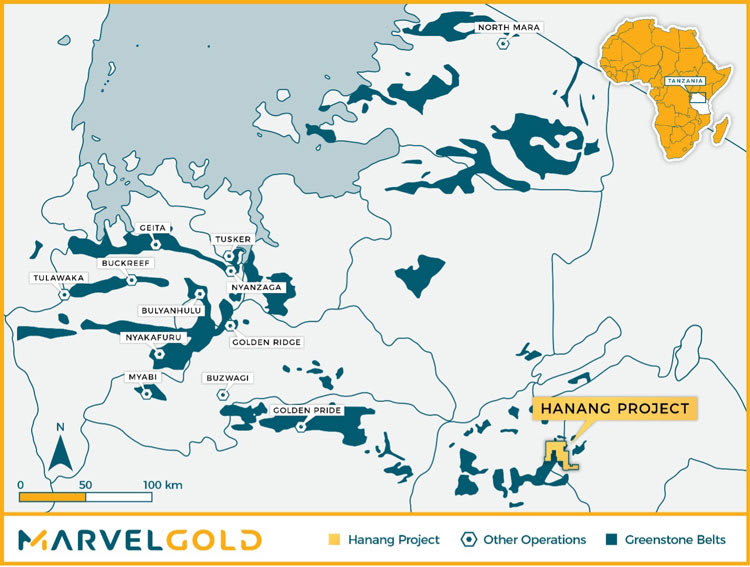
Tanzania's greenstone belts with Geita, Bulyanhulu, North Mara, Golden Pride and Hanang. Hover the marker.
The rules of the game
Statutory Taxes and charges
Mining companies generally pay 30% corporate income tax on taxable income. Gold also attracts a 6% royalty on gross value, plus a 1% inspection and clearing fee on mineral exports. The distinction matters: corporate tax is based on profit, while the royalty and export fee apply before profit is calculated. A mine can owe royalty and inspection fees in a period when its taxable profit is low or nil.
Statutory State participation
For a mining licence or special mining licence, the Government is entitled to not less than 16% non-dilutable free-carried interest in the mining company. "Free carried" means the Government receives shareholder rights without subscribing or contributing equity capital for those shares. "Non-dilutable" means later equity issues cannot reduce the Government's minimum percentage.
The 2022 State Participation Regulations set out the structure. A Tanzanian joint-venture company is established with the Government as shareholder, the mining licence is issued to that company, and mineral-sale proceeds are held in Tanzanian accounts. The Government's interest sits in the local project company, not in the foreign-listed parent.
The Mining Act also allows the Government to acquire additional shares, up to 50% in total, where linked to tax expenditure or incentives provided to the mining company.
Negotiated per project Implementation
The requirement for a framework agreement, shareholders' agreement and joint financial model is statutory, but the terms inside those documents are negotiated. They settle governance, economic-benefit sharing and project-specific arrangements, including any interest above the statutory floor. Barrick's Twiga arrangement includes a negotiated 50-50 sharing of economic benefits - that is a settlement-specific structure, not the automatic rule for every Tanzanian mine.
A simple example: if a listed parent initially owns 100% of the local mining company and the Government receives 16%, the parent's interest in that company becomes 84%.
Investors still own the same percentage of the listed parent, but the parent's indirect project ownership is 84%, before taxes, royalties or any additional agreed State interest.
Follow Hanang as it unfolds
Join Marvel's investor hub to get announcements as they land and put your questions directly to the team.
What changed
The reset
Tanzania amended the Mining Act and passed laws asserting permanent sovereignty over natural resources and allowing review of agreements considered unconscionable. State participation was strengthened.
The disruption
A ban on copper-gold concentrate exports and a major dispute with Acacia Mining disrupted operations and confidence. Exploration capital largely left - one 2020 industry update described a four-to-five-year exploration hiatus.
The settlement
Barrick acquired Acacia's minority interests, formed the Twiga partnership with the Government and negotiated a resolution. The concentrate ban lifted and operations restarted.
The rulebook
The State Participation Regulations supplied detailed templates for joint ventures, framework agreements and shareholder rights, giving today's regime clearer mechanics.
That history explains why exploration capital slowed and then returned. It also explains why investors should treat today's clearer mechanics as progress, without forgetting that Tanzania has shown it is willing to change mining settings quickly.
Who else is there
Barrick
Operates both mines through Twiga, its partnership with the Tanzanian Government.
AngloGold Ashanti
Owns and operates Geita and has restarted greenfields exploration, including a US$9 million farm-in under which it may earn 70% of the Golden Eagle project.
Perseus Mining
Owns the Nyanzaga development project.
Their presence matters because these are companies committing operating capital, exploration budgets and management teams under the current regime. That is a practical signal of jurisdiction confidence. It is not proof that political risk has disappeared, or that every company will receive the same negotiated terms.
What this means for Marvel shareholders
Marvel's Hanang Gold Project sits in the underexplored Iramba-Sekenke greenstone belt, and maiden reverse-circulation drilling commenced on 29 May 2026. The 2017-2020 exploration slowdown helps explain why parts of Tanzania's greenstone belts received less modern work, but "underexplored" does not mean lower risk or guaranteed discovery.
At Hanang's current stage, shareholders are mainly exposed to exploration execution and licence tenure. The minimum 16% free-carried interest applies to the company holding a future mining licence or special mining licence - not to MVL itself, and not to prospecting-stage drilling. The fiscal and State-participation settings become directly relevant at mine-development and mining-licence stage.
Frequently asked questions
Does the Tanzanian Government receive 16% of the listed parent company?
No. The statutory interest is held in the mining or joint-venture company associated with a mining licence or special mining licence. It reduces the foreign parent's indirect ownership of that local company, rather than issuing the Government shares in the overseas listed parent.
Does the 16% rule apply during exploration?
The statutory free-carried interest provisions apply to operations under a mining licence or special mining licence. A prospecting licence is the exploration-stage right, so the State equity structure does not apply in the same way to exploration holdings.
Does the Government pay for its free-carried shares?
No equity contribution is required for the free-carried shares, including when the local company increases its share capital. The minimum interest is non-dilutable, and the Government receives shareholder and governance rights set out in the regulations and project agreements.
Are the 6% royalty and 1% fee calculated on profit?
No. The gold royalty is calculated on gross value, and the inspection and clearing fee applies to mineral export value. Corporate income tax is the main charge in this summary calculated on taxable income.
Does the presence of major miners make Tanzania low risk?
No. It shows that experienced groups are prepared to invest and operate under the current framework, which is useful evidence of confidence. It does not erase the 2017-2020 disruption, the State's strong statutory position or the need to negotiate project-level agreements.

Questions about Tanzania or Hanang? Ask them directly on the hub - the Marvel team answers here.